


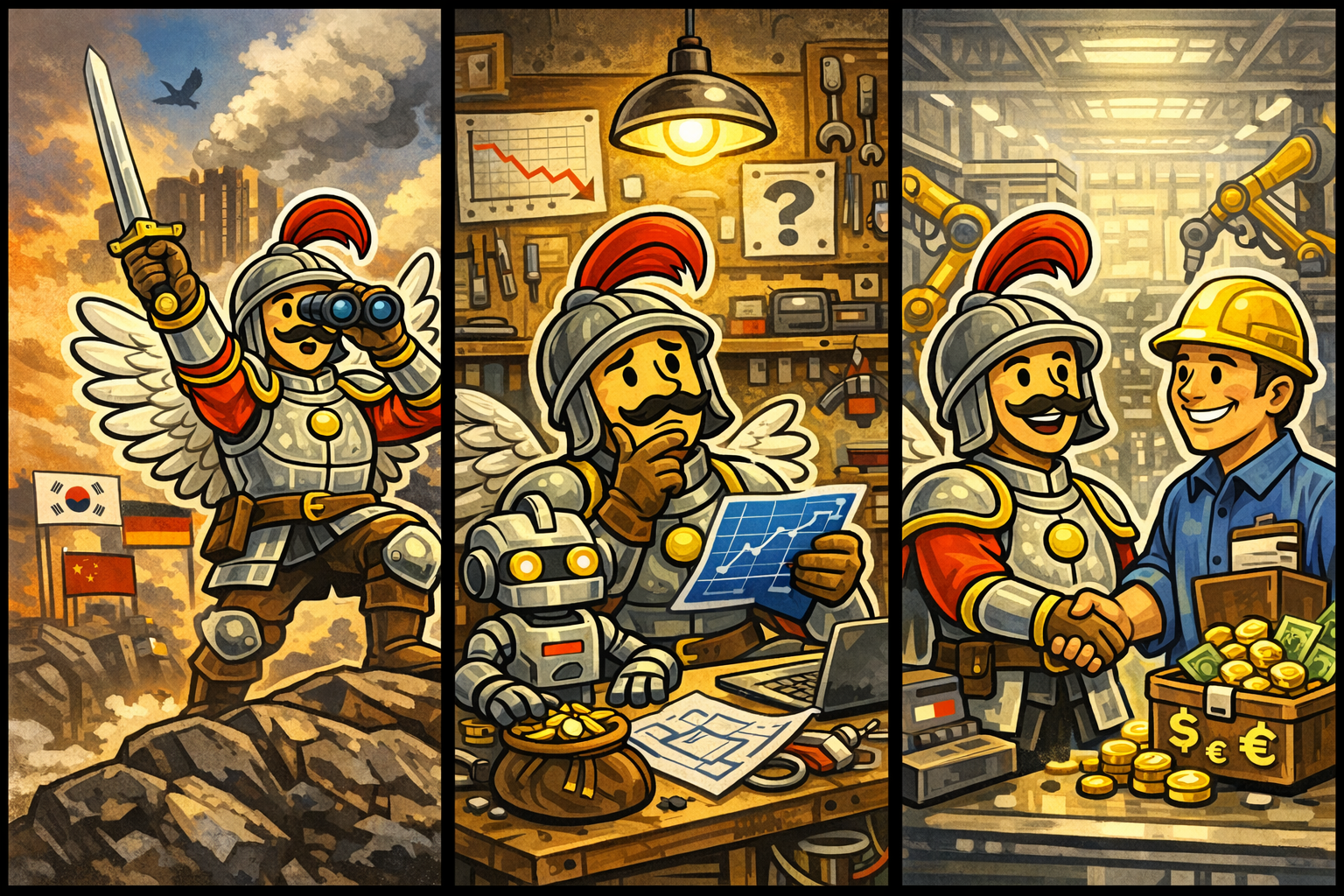
There are wars that don’t thunder with artillery. They go on quietly. Without marches. Without flags.
But the losers in them grow poorer the same way as after a real war.
This is the war of robots.
While politicians argue about migration, inflation, and energy prices, factories around the world are deploying a new army — cold, precise, cheap to operate. It doesn’t strike. It doesn’t go on sick leave. It doesn’t ask for a bonus. And it always comes to the shift on time.
Poland in this war is, for now, in the position of an “observer with binoculars.” And that is already a problem.
According to industry reviews and IFR publications, the density of robotization in Poland is about 78 industrial robots per 10,000 workers, while the world average is 162. Poland is about 28th in the world by this indicator.
Dry statistics turn into a blow when you look at the dynamics:
in 2023 Poland installed 2,685 robots, which meant –15% versus the previous year and the third year of decline in a row, a rollback almost to the 2018 level.
These are not just numbers. This is a trajectory.
The trajectory of a country that got used to winning “with hands,” but has entered an era where they win “with automation.”
The world doesn’t wait: the global machine has switched on
In the world, by the end of 2023, 4,281,585 industrial robots were operating — growth of +10%.
In 2023, about 541,000 new industrial robots were installed (the second-best result in history, though with a small year-on-year decline).
IFR says it directly: demand for robots “generally grows” and the trend does not look like a temporary spike. Forecast:
575,000 installations in 2025 (+6%),
700,000+ installations per year by 2028.
This is not “it will happen someday.” This is already a schedule.
Humanoids are not a show. This is a new category of workers
The paradigm has changed: before, a robot was a “machine tool with hands” and lived behind a fence. Now the robot is learning to live among people — in warehouses, in workshops, in logistics.
Mercedes-Benz is not a blogger and not a futurist. It is a corporation that counts money and risks. And it is already testing Apptronik Apollo humanoid robots in production — for moving components and quality checks — and it even invested in Apptronik a “double-digit amount in millions of euros.”
GXO Logistics (a large contract logistics operator) is testing the Digit humanoid robot from Agility Robotics at a real site (including at a SPANX facility), and this is not a “demo for the sake of demo”:
there are pilots,
there is a multi-year agreement,
there is the RaaS model (Robots-as-a-Service) and a cloud platform for managing a fleet of robots.
This is important: the robot stopped being a “purchase of hardware.” The robot became a service. And a service is a market.
Why Poland is losing — short and tough
Poland is losing the robot war not because it has no brains.
Poland is losing because it lived too long on one trump card: cheap hands.
And that trump card burned out.
When you win by the price of labor — you don’t invest in machines.
When labor gets more expensive — you suddenly discover that the leaders have already built factories where robots are the basic package, like electricity.
And you are still arguing whether you need a generator.
And here the most important thing begins: about money.
Because “robots” are not only about threats. This is about new professions, new business models, and new sources of income.
“Where is the money here: how they really make money on robots”
If you remove the fantasies about “robots will take jobs” and “everyone will become unemployed,” a dry fact remains:
robotization is a market of services, not a market of hardware.
Hardware has low margins.
Services, integration, operation, AI, training — that’s where the money is.
And it is exactly here that Poland has a huge window of opportunity.
1. Robotics integration (the most underestimated market)
Most companies don’t know what to do with a robot, even if they bought it.
A robot by itself is useless.
Value appears when:
it is built into an existing line,
connected with ERP / WMS / MES,
staff are trained,
the process is optimized.
A real example
Symbotic is an American company that automates the warehouses of Walmart, Target, and other giants.
Symbotic makes money not on selling robots, but on:
design,
implementation,
customization,
servicing systems.
Their revenue is billions of dollars, while the robots themselves are only part of the system.
Conclusion:
Poland does not need to “invent its own FANUC.”
Poland needs to become the integrator of Europe.

2. Robots-as-a-Service (RaaS): subscription instead of purchase
The model is changing radically.
Companies do not want to buy robots:
expensive,
risky,
hard to write off.
They want:
to pay monthly,
to get the result,
not to think about servicing.
Real cases
GXO Logistics uses the RaaS model for Digit humanoids
Locus Robotics and 6 River Systems (Amazon) — warehouses by subscription
Clients pay for a processed unit, not for “hardware”
What this gives Poland
you can launch small and medium companies,
you don’t need a factory,
you need service + engineers + SLA.
This is an ideal model for:
regions,
expats,
SMEs.
3. Maintenance and operations (a quiet gold market)
Robots break.
Robots need:
maintenance,
updates,
calibration,
safety.
Every installed robot is 10–15 years of service.
Reality
In Germany and Japan, service contracts can bring 40–60% of a robotics project’s lifetime revenue.
In Poland:
there are not enough service specialists,
companies depend on foreign engineers,
downtime is expensive.
Opportunity:
local service firms, mobile teams, regional hubs.
4. “Brains” for robots: AI and computer vision
Hardware is getting cheaper.
Brains are getting more expensive.
Where the real money is:
machine vision for quality control,
object recognition,
trajectory optimization,
digital twins of production.
Why Poland is strong here
a powerful IT sector,
outsourcing experience,
engineers are cheaper than in the West.
Companies like Siemens, ABB, Bosch increasingly buy software and teams, not machines.
Important:
one algorithm can run on thousands of robots.
5. Warehouse and logistics automation (the fastest ROI)
Warehouses are the perfect environment:
repetition,
labor shortages,
growing e-commerce.
Fact
In Poland, Amazon showed the model:
4,000 robots + 1,000 people = productivity growth without layoffs.
Robots:
move,
sort,
optimize routes.
People:
manage,
maintain,
control.
The ROI for these projects is often under 2–3 years.
6. Training and certification (the market nobody talks about)
Robots exist.
People who know how to work with them — don’t.
What is already happening
companies pay to train staff,
vocational schools and universities can’t keep up,
the corporate training market is growing.
Courses:
cobot operator,
maintenance technician,
integration engineer.
This is a market with constant demand, especially in the regions.
7. Robotics consulting (more expensive than it looks)
Companies ask one question:
“Where do we start — and how do we not get killed doing it?”
The answer is not “buy a robot.” The answer is:
process analysis,
choosing the automation point,
ROI calculation,
a step-by-step plan.
This is not IT consulting. This is production intelligence.
8. Why Poland is the perfect place for this market
Poland is:
in the center of the EU,
with a huge industrial base,
with rising wages,
with a labor shortage.
But the key thing:
Poland is not overheated like Germany,
and not drowned in regulation like France.
It is a rare balance.
Where Poland belongs — and why it still has time
There is one illusion Poland lived with for too long: the idea that if you don’t manufacture technology, you are doomed to be second forever. That is not entirely true. In the 21st century, the winner is not the one who makes the “metal,” but the one who controls implementation. And that is where Poland is still not at the roadside — it is at the crossroads.
The world of robotization is no longer divided into “producers” and “buyers.” It is divided into those who can embed complex systems into the real economy — and those who just order boxes with an English manual.
Germany is strong because it built an ecosystem of engineers and integrators for decades.
China is strong because it fused state, business, and scale.
The USA is strong because it turned robots into a service — a subscription, an API.
Poland ended up in a strange position. On the one hand — a massive industrial base: auto components, food processing, logistics, warehouses, recycling, chemicals. On the other — labor shortages, rising wages, pressure from Western Europe and global corporations.
This is not a crisis. This is a point of tension. And points of tension create markets.
Poland does not have to make its own robots. That is not defeat. Poland can do what the leaders don’t want to do: the complex, dirty, context-heavy work of adapting robotization to real business. To old workshops. To crooked processes. To people who never read documentation and don’t want to read it.
To accounting, unions, inspections, safety rules, shifts, overtime, and the real chaos of production.
Real-world robotization is not an expo. It is not white walls and perfectly aligned lines. It is compromises. Workarounds. Transitional solutions. And what you need here are not futurists — you need practitioners.
Poland can become a country of practical robotization — if it stops seeing itself as “the one catching up.”

Warehouses are the first example
Poland has already become Europe’s logistics hub. This is not a slogan; it is a fact. Goods flow through it west-to-east and back again. But logistics without automation is hell. People leave. People get sick. People don’t come to shifts.
Warehouse robots are not the future — they are a survival tool. And the money is not in the robots. It is in the one who takes responsibility for the result. For the box arriving. For the order being picked. For the customer not leaving.
This is a service economy disguised as technology.
Manufacturing is the second layer
Most Polish factories are not new. They were built for people, not robots. You can’t just “automate” them. You have to rethink them. This is work for engineers, analysts, integrators — people who understand how production lives, not how it looks on a slide.
Here Poland can export not metal, but teams. Teams that can walk into production and bring order step by step. These are long contracts. Repeat revenue. Reputation.
AI is the third layer — the most underestimated one
Robots without AI are just automated machines. Value is created when a robot starts to see, understand, adapt. Poland is strong in software — everyone knows that. But instead of writing yet another fintech app or CRM, you can write “brains” for robots: quality-control algorithms, flow optimization, failure prediction, digital twins.
One such algorithm can live across hundreds of factories. This is scalable business. This is export without logistics. This is an economy of meaning, not steel.
And what if not to win?
And here the key moment appears. Poland does not have to win this war alone. It has not been alone for a long time. Hundreds of thousands of engineers, technicians, developers from Ukraine, Belarus, Eastern Europe live in the country. People who worked in conditions of shortage, instability, the absence of ideal conditions. They are used to making systems that work, not systems that look pretty. This is a huge, but so far poorly realized asset.
Robotization is not about nationality. It is about experience. About the ability to connect incompatible things. About the ability to explain the complex in simple words. About patience. And if Poland manages to turn this human capital into a systemic force, it can win not the race, but the role. The role of a country where robots become part of the economy, not a museum exhibit. Where automation is not a “top-down” project, but a normal business tool. Where nobody waits for the perfect moment, because perfect moments do not exist. There is only now.
Sometimes it seems that Poland is late. But if you look closer, it has simply come to a point where there is no choice anymore. And in such moments countries either make a leap, or get stuck for a long time. History suggests that Poland knows how to make leaps. The only question is where it will jump. Into automation — or into nostalgia for cheap hands and old schemes. Though this already smells like a refrigerator.
Why this is important now and what Dzelka.pl has to do with it
In any war there is a moment when it is already pointless to discuss who was right earlier. Only one question remains — what to do now, when the rules have already changed, and there is no return to the past.
With robots it is exactly like that.
You can talk as much as you want that Poland is “not ready yet,” that “the market is raw,” that “people are afraid,” that “it’s too expensive.” All of that is true. But the truth is also the other thing: robots will come anyway. Not because it is beautiful or fashionable, but because without them the economy stops adding up. There are fewer people. They are more expensive. Processes are more complex. Speed matters more. Mistakes cost more. And at some point business simply runs out of choices.
In this sense Poland is not unique. What is unique is something else: it came to this point not as a scorched desert and not as an overheated market, but as a living, working economy where the rules can still be reassembled. Not rewritten from scratch, but reassembled — carefully, layer by layer, without revolutionary fanaticism.
And here a question arises that almost nobody asks out loud:
where is the place of platforms in this story at all?
Not factories.
Not robot manufacturers.
Not corporations with multi-billion turnover.
But exactly platforms that connect people, business, knowledge, services, reputation, and the rules of the game.
Robotization is not a “buy–sell” market. It is a market of trust.
You are not buying a robot — you are trusting that someone:
correctly assessed the process,
won’t break production,
won’t leave you with a piece of metal and a manual,
will be there when something goes wrong (and something will definitely go wrong).
At this point classic marketplaces break.
Social networks are useless.
Corporate websites are dead.
An infrastructure is needed where:
roles are clear (integrator, engineer, business, service),
there is reputation, not an avatar,
there is the context of the country, laws, language,
there is an opportunity to learn, make mistakes, and grow,
and where automation is not an abstraction, but concrete steps.
And this is where Dzelka.pl appears.
Not as a “platform about robots.”
But as a platform for a new economy, where robots are only one of the tools, but a very revealing one.
Because robotization exposes everything:
weak processes,
unprepared people,
chaos in management,
fear of the complex.
And if a platform is capable of holding such complex topics — it is capable of holding everything else, too.
Dzelka.pl in this logic is not a showcase and not an aggregator. It is a space of assembly. A place where business finds not a “performer,” but a bundle of solutions. Where an engineer does not look for a “job,” but becomes a participant in an ecosystem. Where expats do not dissolve, but integrate. Where the local market stops being a province and becomes a node.
This is not about robots as such.
This is about a way of entering the future.
Poland is losing the robot war not because it is weak.
And not because someone is “better.”
It is losing because for too long it did not want to admit that the world moved to a different level of complexity.
But the good news is that the war is not lost yet.
It has simply entered the phase where the winners are not the fastest and not the richest, but those who know how to connect.
Connect people with technologies.
Business with reality.
Experience with opportunities.
Mistakes with conclusions.
Robots will not take work away from Poland.
Refusal to change will take work away from Poland.
And if Poland manages to stop being afraid of complexity and starts turning it into infrastructure — it may, unexpectedly for many, come out of this war not a winner on points, but a player who sets the rules of the next round.
And that, in the long run, is always more expensive than any robots.